
Sit down at a live table on your phone tonight and the gap between the dealer’s hand and your screen is barely there. Try the same thing a decade ago and the stream would have stalled, buffered and broken exactly when something interesting was happening. What changed has less to do with casinos than with the network underneath them, and in India that shift arrived unusually fast.
By August 2025, the median mobile download speed in India had climbed to roughly 131 Mbps, according to Ookla’s Speedtest data reported by Voice&Data. A few years ago that figure sat in the low double digits.
The country’s Department of Telecommunications confirmed in its 2025 year-end review that internet connections crossed one billion for the first time, and that surge in speed is exactly what makes a modern online casino feel so much closer to a real venue.
Hold onto those two facts, because together they explain something you might have felt without quite naming it: live dealer games feel closer to a real table than they used to. The games themselves didn’t change. Everything carrying them to your phone did.
Let’s walk through why, from the connection to the dealer to the games that suit this format better than any others.
The Signal Caught Up to the Game
Live dealer games have been around for years. What held them back wasn’t the idea; it was the pipe feeding them to you. A real-time stream of a spinning wheel or a dealt hand needs steady bandwidth and low lag, and for a long time most connections here couldn’t promise either.
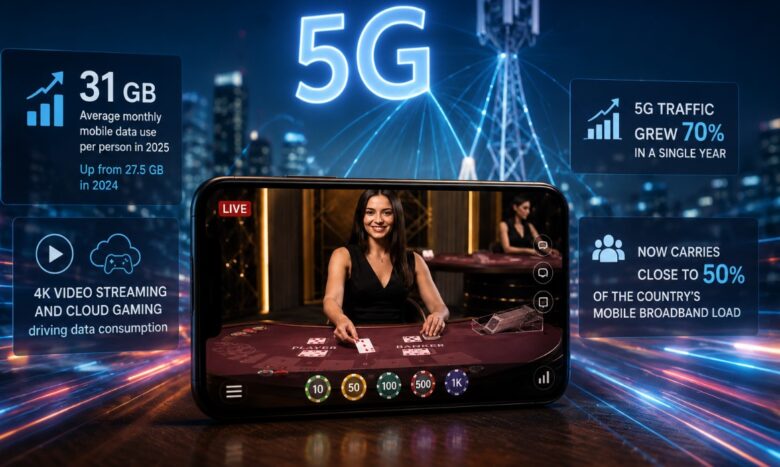
That changed fast. Average monthly mobile data use per person crossed 31 GB in 2025, up from 27.5 GB the year before, according to the Nokia MBiT Index reported by Business Standard. The same report points to 4K video streaming and cloud gaming as the reasons we’re all consuming so much more. On top of that, 5G traffic grew 70% in a single year and now carries close to half of the country’s mobile broadband load.
Nobody laid this groundwork for casino streams. You’re riding the same network that delivers cricket in high definition and video calls to relatives three states away. Live tables hitched onto a much bigger wave, and that’s why the experience arrived feeling finished rather than experimental.
Same Table, Now With a Pulse
So the connection is solid. What’s it delivering to you exactly?
A person. That’s the difference between a live table and a random-number version of the same game. You watch someone shuffle the cards. You see the wheel spin in real time. The result happens in front of you, at a pace a machine doesn’t set.
Think of the dealer less as entertainment and more as proof. When you can see each step as it happens, there’s little room left to wonder whether the outcome was decided somewhere you couldn’t look. That visible fairness persuades, and the numbers suggest players agree.
Grand View Research reports in its online casino market analysis that the live dealer segment is forecast to grow at nearly 13% a year between 2025 and 2030, on the back of rising player preference for the format. Zoom out and the wider live dealer market reached USD 8.6 billion in 2025, growing above 10% annually, per Growth Market Reports.
It’s a modest slice of a very large industry. But it’s the slice growing fastest, and that’s a good indication of where attention is heading.
Why Andar Bahar Was Built for This

The format shines brightest with games you already know. Complexity is the enemy of a smooth live experience; the best fit is something simple, quick and familiar enough that the dealer’s presence adds tension rather than confusion.
India happens to be rich in exactly those games. Providers now run tables designed specifically for players here, with dealers speaking native languages and game shows timed around festivals, covering favourites like Andar Bahar and Teen Patti, as detailed by industry site Casinoble. Read that as localisation rather than something imported and dressed up. A game learned around a table at home, dealt live in a language you think in, lands very differently from a generic port. For a sense of how card play travels across cultures, the Encyclopaedia Britannica traces just how far these traditions reach.
What draws people to the live versions tends to come down to a few things:
- Seeing the action unfold live, which builds a sense of straightforward fairness
- Playing games you grew up with, now dealt in your own language
- Real-time chat and shared moments that a solo digital screen can’t offer
- Familiar rules, so your attention goes to the play rather than the learning
And if a game you first picked up at a family gathering can now be dealt to you live, in your language, on the device in your hand, where does the real thing really live now?
The Table Came to You
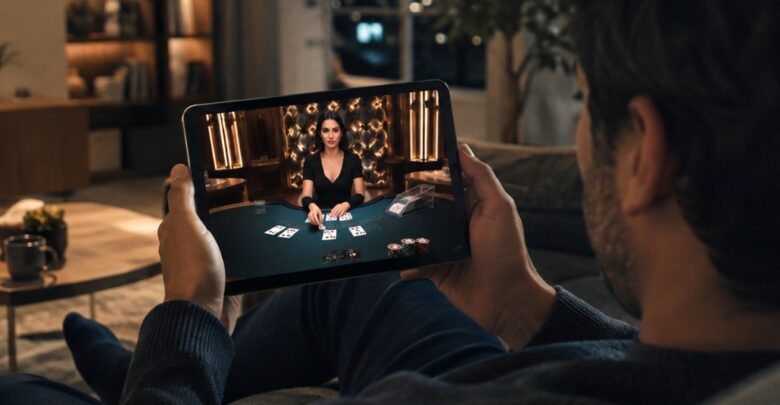
We tend to describe all this as people leaving physical tables for screens. That framing misses what happened.
The qualities that made a physical table worth sitting at, a real dealer, a genuine outcome, a moment shared with others, travelled down fibre and 5G to reach people who might never have sat at one. The table came to you, not the other way round.
And it’s still spreading. Vodafone Idea began its 5G rollout in 2025, joining Jio and Airtel, Voice&Data reports, which pushes steady coverage further into tier-2 and tier-3 towns. The experience gets smoother from here, not shakier.
So the realism was never a trick of design. It’s good infrastructure meeting games you already love, arriving at the same time. When the stream is this steady and the game is this familiar, what’s genuinely left to tell the two apart?