
The modern workplace is currently undergoing a quiet, yet profound, revolution. For decades, “efficiency” meant working harder, faster, and longer. Today, that definition has been rewritten by a new generation of digital architects. In the race to remain competitive, organizations are moving beyond basic digitization and toward a reality where intelligence is embedded into the very fabric of their operations. At the heart of this shift are AI workflow automation tools, a category of software that is fundamentally changing how humans and machines collaborate to achieve business goals.
The journey toward a streamlined office has been a long one. We have moved from the era of physical paperwork and manual filing to a period of basic digital tracking. However, even early software often mirrored the inefficiencies of the past, requiring constant human intervention to bridge the gaps between different platforms. With the integration of artificial intelligence, we are finally seeing the “bridge” build itself.
The Evolution of the Invisible Engine
Source: usemotion.com
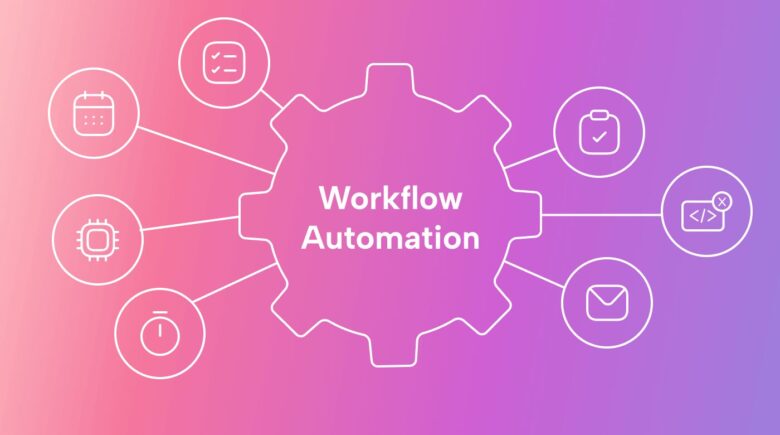
Workflow automation has mirrored technological advancement in its sheer complexity. In its early iterations, process management was predominantly manual. It was characterized by physical documentation, time-consuming administrative hand-offs, and a heavy reliance on human memory to transition tasks from one phase to another. As businesses expanded, it became apparent that manual processes were fraught with risk. Errors multiplied, communication gaps widened, and productivity stalled under the weight of “busy work.”
The first wave of relief came through rudimentary software tools that offered basic task scheduling. While helpful, these systems were rigid. They followed “if-this-then-that” logic but lacked the ability to interpret nuance or handle exceptions. In recent years, we have witnessed a seismic shift toward sophisticated automation underscored by artificial intelligence.
AI-powered solutions do not just automate repetitive tasks; they analyze vast datasets, identify hidden patterns, and make decisions in real time. This transition from basic task-tracking to AI-driven processes represents a pivotal transformation. It renders organizations more agile and responsive to market dynamics. The landscape is now populated with AI workflow automation tools that integrate seamlessly across departments, adapt to changing environments, and provide actionable insights that were previously buried in data silos.
Why Intelligence is the Future of Optimization
Artificial intelligence is rapidly becoming the cornerstone of efficient operations because it offers something manual systems never could: the ability to learn. Through machine learning algorithms, modern systems analyze existing workflows to identify bottlenecks and suggest improvements. This creates a continuous cycle of optimization where the system becomes more intelligent with each completed task.
The predictive capabilities of AI are equally transformative. By leveraging historical data and current trends, these tools can forecast future demands. In sectors like supply chain management, predictive analytics can anticipate inventory shortages before they occur. This enables preemptive actions that mitigate disruption before a customer even notices a delay. As the technology evolves, its integration into the daily grind will not only reduce operational costs but also enhance the overall maturity of the workforce. When the machine handles the mundane, the human is free to focus on high-value, creative strategy.
The Selection Criteria: What Defines a High-Quality Tool?

In an saturated market, choosing the right AI workflow automation tools is crucial for achieving a tangible return on investment. Effective solutions generally share several essential features that distinguish them from sub-par options.
Customization and Flexibility: A “one-size-fits-all” approach rarely yields results in a complex business environment. The ideal tool must adapt to specific organizational needs without requiring an expensive, top-to-bottom overhaul. Flexibility to mold the software around unique, proprietary processes is a non-negotiable requirement.
User Experience (UX): Tools that prioritize a user-friendly interface see significantly higher adoption rates. If a system is overly complex, it results in employee frustration and decreased productivity, defeating the purpose of the investment. Organizations should look for solutions that offer intuitive design coupled with robust training resources.
Seamless Integration: Operational gaps usually exist at the intersection of different software. The right tool must communicate flawlessly with existing systems, from Customer Relationship Management (CRM) applications to Enterprise Resource Planning (ERP) databases. Without this “digital glue,” information cannot flow freely across the organization.
Scalability: As a business grows, its technological needs evolve. An effective tool must be able to scale alongside the company. This includes the ability to accommodate a growing user base, add new functionalities, and adapt to the broader technological environment.
The ROI Debate: Evaluating the Investment
When deliberating the implementation of AI, cost-effectiveness is always the primary concern for leadership. Organizations often struggle to balance high initial investment costs against long-term benefits. However, a comprehensive cost-benefit analysis usually tips the scales in favor of automation.
Beyond the software subscription price, businesses must consider the projected increase in output and the massive reduction in “human error” costs. There is also the opportunity cost of time; every hour a skilled employee spends on manual data entry is an hour they are not spending on innovation or client relations.
Hidden costs must also be accounted for to get an accurate picture. Implementation time, staff training, and ongoing maintenance fees contribute to the total cost of ownership. It is vital to demand a transparent pricing structure from vendors. While the upfront expenditure may seem significant, the long-term advantages in accuracy and adaptability typically make it one of the soundest strategic decisions a modern firm can make.
Intelligence in Action: Real-World Transformations

Source: jorie.ai
The power of AI workflow automation tools is best understood through the success stories of industry leaders. In the manufacturing sector, a multinational company integrated AI-driven robotic process automation (RPA) into its assembly lines. By allowing robots to handle high-volume, repetitive tasks, the company reported a 30% increase in production efficiency. This shift did more than just boost numbers; it enhanced workplace satisfaction by allowing human workers to focus on complex problem-solving.
In the retail world, a leading online merchant adopted AI for customer service operations. By implementing chatbots powered by natural language processing (NLP), the retailer transformed its support model. These bots can handle thousands of inquiries simultaneously, slashing wait times and improving retention rates. These stories underscore a vital point: when AI is harmoniously blended with human capability, the results are transformative.
Industry-Specific Challenges and Solutions
While the benefits are universal, each sector faces unique hurdles. In healthcare, the accuracy of AI models is a life-or-death matter. Implementing AI for patient triage requires meticulous validation. To counter the risk of incorrect assessments, healthcare entities invest heavily in training their tools on diverse datasets that reflect a wide range of patient scenarios.
The finance industry, meanwhile, is navigating the complexities of regulatory compliance. With stringent guidelines governing every transaction, AI tools must be programmed to monitor activities in real time to flag suspicious patterns. In this context, AI does not just optimize a process; it fortifies the institution against fraud and compliance violations. The adaptability of AI allows for quick updates to keep pace with changing federal regulations, safeguarding the firm’s reputation while promoting day-to-day efficiency.
Overcoming the Hurdles of Implementation
Despite the clear advantages, the road to automation is often paved with challenges. The primary technical hurdle involves integration with legacy systems. Many organizations rely on “old” software that was never intended to communicate with modern AI. This can lead to data silos and process fragmentation. To mitigate this, businesses should conduct a thorough audit of their current technologies before deployment. Opting for modular AI solutions—tools that can enhance specific functions without requiring a total system replacement—is often the most pragmatic strategy.
The final, and perhaps most difficult, hurdle is organizational culture. Resistance to change is a natural human reaction, often stemming from a fear of job displacement or a lack of technical understanding. To foster a culture of adaptability, leaders must position AI as a partner rather than a replacement.
Comprehensive training programs are essential to transform apprehension into empowerment. By teaching employees how to leverage these tools to make their own jobs easier, businesses can ensure high levels of “buy-in.” Techniques such as mentorship programs and feedback loops help bridge the gap between technology and human execution. When employees see AI as a tool that removes the “drudgery” of their day, they become the biggest advocates for the new system.
The New Standard of Excellence
Source: litslink.com
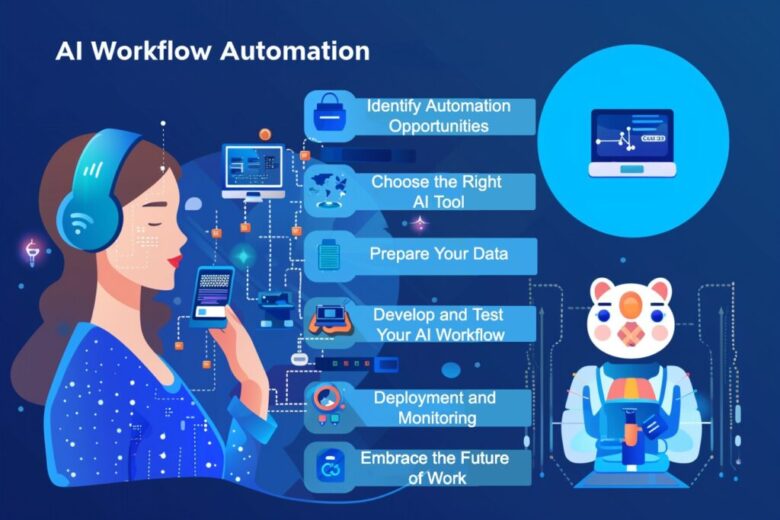
The implementation of AI workflow automation tools is no longer a luxury reserved for Silicon Valley startups. It has become a fundamental requirement for any organization that intends to thrive in a globalized, high-speed economy. By understanding the evolution of these tools, choosing the right features, and fostering a culture that embraces change, businesses can unlock levels of productivity that were previously unimaginable.
Automation is not just about doing things faster; it is about doing things smarter. It is about creating an environment where data is actionable, processes are fluid, and human talent is utilized to its highest potential. As we move further into the decade, the divide between the leaders and the laggards will be defined by their ability to integrate intelligence into their daily workflows. The tools are ready; the question is whether your organization is ready to use them.